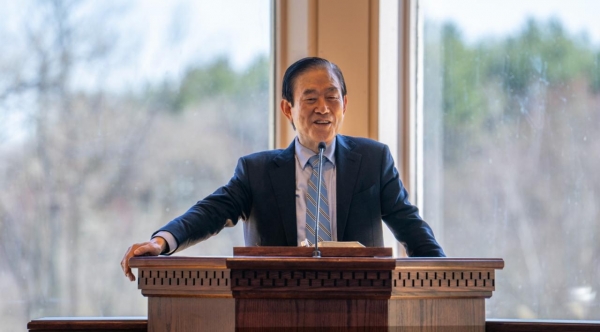
At times, the very hands we extend to receive the bread of Communion cling only to our own rights once the worship service is over. Why should our confession that we have shared the same bread lead to a life of consideration for one another? In his sermon on 1 Corinthians 10, Pastor David Jang, founder of Olivet University in the United States, explains that Communion, through which believers participate in Christ’s body and blood, binds them together as one body and calls them to serve one another. As we come to understand this grace, our question deepens from “What am I free to do?” to “Whose faith can I strengthen through my freedom?”
The Meaning of Communion: One Body Sharing in One Loaf
In 1 Corinthians 10:16–17, Paul describes the cup of blessing as participation in the blood of Christ and the bread we break as participation in the body of Christ. He then explains that the many believers are one body because they share in the one loaf. The meaning of Communion embraces both union with Christ and the confession that believers are bound to one another. Those who receive the Lord’s love are called to see their neighbors, who live by that same love, in a new light.
The sermon understands Communion as a means of grace through which believers participate spiritually in Christ’s sacrificial love. The bread and the cup point to the body and blood of the Lord, who gave himself for our sins. Reflecting on our sins and repenting as we receive Communion goes hand in hand with a deeper embrace of his atoning love. The more we consider the love we have received, the less lightly we can treat those who share in that grace.
Being one body carries with it the responsibility to live for one another within the church. Alongside considering whether our own faith is at peace, we are led to ask how we can help those beside us continue to live in faith. This confession challenges the attitude that notices another person’s weakness yet passes by, saying it is none of our concern. For the struggles of those with whom we share the bread concern us, too.
Our responsibility to serve our neighbors begins with the love we have first received from Christ. When we remember this order, the practice of faith grows into concrete acts of response to grace. Confessing that we share the same bread draws us toward a life in which we come to know one another’s needs and offer our time and strength to meet them.
To Whom Do We Belong in the Face of Temptation and Idolatry?
Even those who belong to Christ can become overconfident in their faith. In 1 Corinthians 10:12–13, Paul urges those who think they stand firm to take care that they do not fall, while also assuring them that God will provide a way out when they are tempted. Memories of having experienced grace cannot replace the work of discerning the temptations we face today. By explaining how Israel faltered in the wilderness despite the grace it had received, the sermon invites us to examine our tendency to turn experiences of faith into self-assurance.
The promise of a way out leads us to rely on God’s faithfulness. When we recognize a pattern of compromise, we need to seek help through prayer and Scripture and change direction under the guidance of the Holy Spirit. The sermon explains that faith can mature as we acknowledge our weakness and learn to depend more fully on God. As we face temptation, we also come to see more clearly what we truly trust and where we stand.
The question of remaining faithful to a life that belongs to God leads to the issue of idolatry. In 1 Corinthians 10:14–22, Paul warns against participating in pagan temple sacrifices, describing such participation as fellowship with demons. To participate in Christ’s body and blood while also seeking union with idols is a contradiction that shakes the very heart of faith. This warning asks to whom we entrust our lives as well as which gatherings we attend.
Pastor David Jang connects this warning to the problem of money, success, pleasure, and media taking a more important place than God. We are to examine what we pursue when using money and technology, and whether those pursuits are displacing our reliance on God. If we repeatedly set aside principles of faith for the sake of achievement, or allow entertainment on a screen to keep taking time away from Scripture and our neighbors, we have reason to reconsider our habits. The question is where the standards that guide our lives come from.
Alongside considering what to reduce, we can also ask what purposes the tools available to us might serve. Using the internet and media to communicate truth and love, and to engage in communication that helps others, is one practical direction the sermon offers. Discernment turns our everyday priorities toward God and helps us find ways to serve.
This discernment does not end with individual resolve. We need relationships within the community in which we listen to one another’s struggles, pray together, and consider what to accept and what to let go. The church, too, must examine whether it is simply following the world’s standards of success. Faith centered on God is revealed both in individual choices and in the priorities of the community.
Whose Faith Does Christian Freedom Build Up?
When reading the warning to avoid idolatry, we must distinguish participation in temple sacrifices from eating meat sold in the marketplace. In 1 Corinthians 10:23–33, Paul affirms the freedom to eat while urging believers to consider how their actions may affect others. Even when the same food is involved, what we need to consider differs according to what we are participating in and how we treat our neighbor’s conscience. Discernment in matters of faith requires careful attention to the situation.
Paul’s emphasis on what is beneficial and what builds others up shows us how to use our freedom. It leads us a step beyond deciding whether an action is permissible, inviting us to consider whether our choice helps another person’s faith and strengthens the community. For those who confess through Communion that they are one body, a neighbor’s faith cannot be treated as a matter separate from their own freedom. The way we exercise freedom must also express love for the people with whom we share our lives.
For example, someone may tell us that an action we can take with a clear conscience presents a difficulty for their faith. We can begin by listening to the reasons for their concern. Before rushing to explain our rights, we can seek to understand what troubles the other person. Willingly choosing to refrain from something we are free to enjoy, for the benefit of that person’s faith, is one way of exercising freedom in love. The moment we ask who will be helped by our choice, our neighbor’s life also becomes part of our decision.
Yet if we yield outwardly while looking down on the other person inwardly, we need to reflect more deeply on what consideration means. Building up the community also includes an inner desire to see another person’s faith grow. When we accept inconvenience while also growing in our regard for the other person, our voluntary restraint becomes sincere service. The love with which Christ gave himself becomes the standard that guides our choices.
From the Cross and Resurrection Hope to Everyday Worship
The service that begins in Communion extends beyond those within the church. Pastor David Jang emphasizes that the grace believers have received together should lead to a responsibility to care for poor and oppressed neighbors and reveal God’s love to the world. Making time to listen to someone’s struggles and working together as a community to provide needed help are also ways of responding to this calling. The love confessed in worship meets the real needs of our neighbors.
Caring for another person involves the effort of giving up some of our own time and convenience. When we cannot immediately see change or find a sense of fulfillment in our efforts, the hope of the resurrection offers strength and comfort as we follow the Lord. The sermon also draws on 1 Corinthians 15, reminding us that Christ’s resurrection lies at the heart of the gospel and of faith. When we hold together the sacrifice revealed on the cross and the hope of life given through the resurrection, faith can help us remain committed to love amid the demands of daily life.
First Corinthians 10:31 urges us to direct even our eating and drinking toward the glory of God. This means that the small choices of daily life are not outside our relationship with him. Reflecting on what we consume, how we spend our time, and the words we use with our neighbors is connected to what we profess in worship.
This is also why the sermon connects the living sacrifice of Romans 12:1 with worship in everyday life. As we listen to the Word, we receive a standard by which to examine our plans; in Communion, we remember the love that is the basis of our response to that Word. If our confession that we belong to God is to take shape in our actual lives, we must be willing to bring even familiar priorities and decisions already made before the Word for renewed examination.
We can now look at today’s schedule and choices in light of the love we have received in Communion. We can begin by making time for care we have postponed, or by setting aside a little of our own convenience to help strengthen someone’s faith. We need a brief pause to ask whether the freedom given to us is being used in ways that bring life to the community. The hands I extended to receive the bread of Communion—toward whose needs are they reaching today?
Dr. David Jang has proclaimed the gospel in various regions of the world through field missions and digital media ministry, and as the fruit of that ministry, many people devoted to the Great Commission have been raised up. Based on this missionary vision, Olivet first began as a small church school for missionary training. Later, in order to provide more systematic theological education and cultivate missionary leaders, Olivet Theological College and Seminary was established in Los Angeles and Seoul in 2000.
As the school grew, Dr. Jang officially founded Olivet University in San Francisco in 2004. In the diverse and dynamic environment of San Francisco, Olivet expanded its educational fields beyond theology to include music, journalism, art and design, and technology. The university also strengthened its educational capacity by recruiting faculty members, including Dr. William Wagner, and in 2005 moved to the former UC Berkeley Downtown Extension campus, further solidifying its foundation as a university.
In 2006, Dr. Jang transferred the presidency to Dr. David James Randolph in order to focus more fully on missionary work, while continuing to lead global missions as International President. Olivet University later received institutional accreditation in 2009, added a language education college and a business college, and continued to grow as a Christian educational institution for world missions by expanding its degree programs and international partnerships.